For engineers with a library full of courses they never finished
Learning that
shows up.
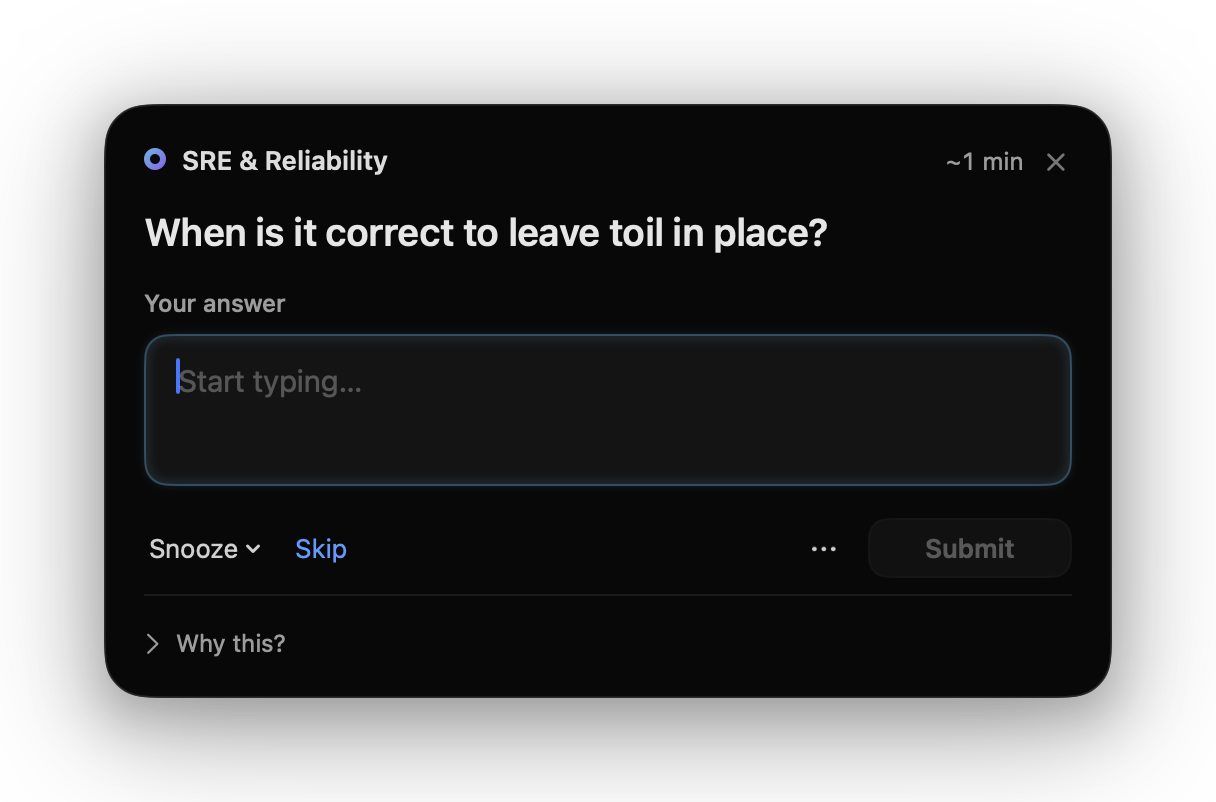
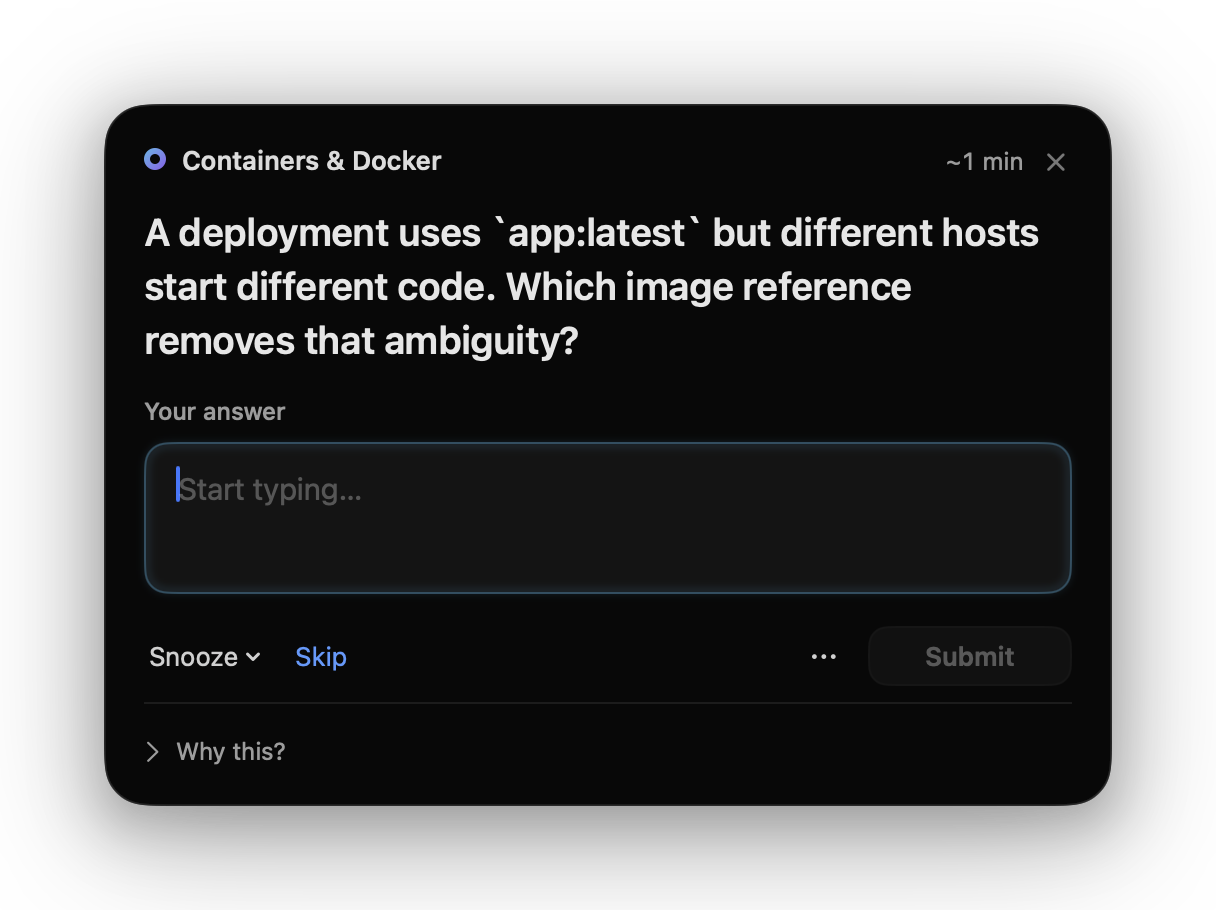
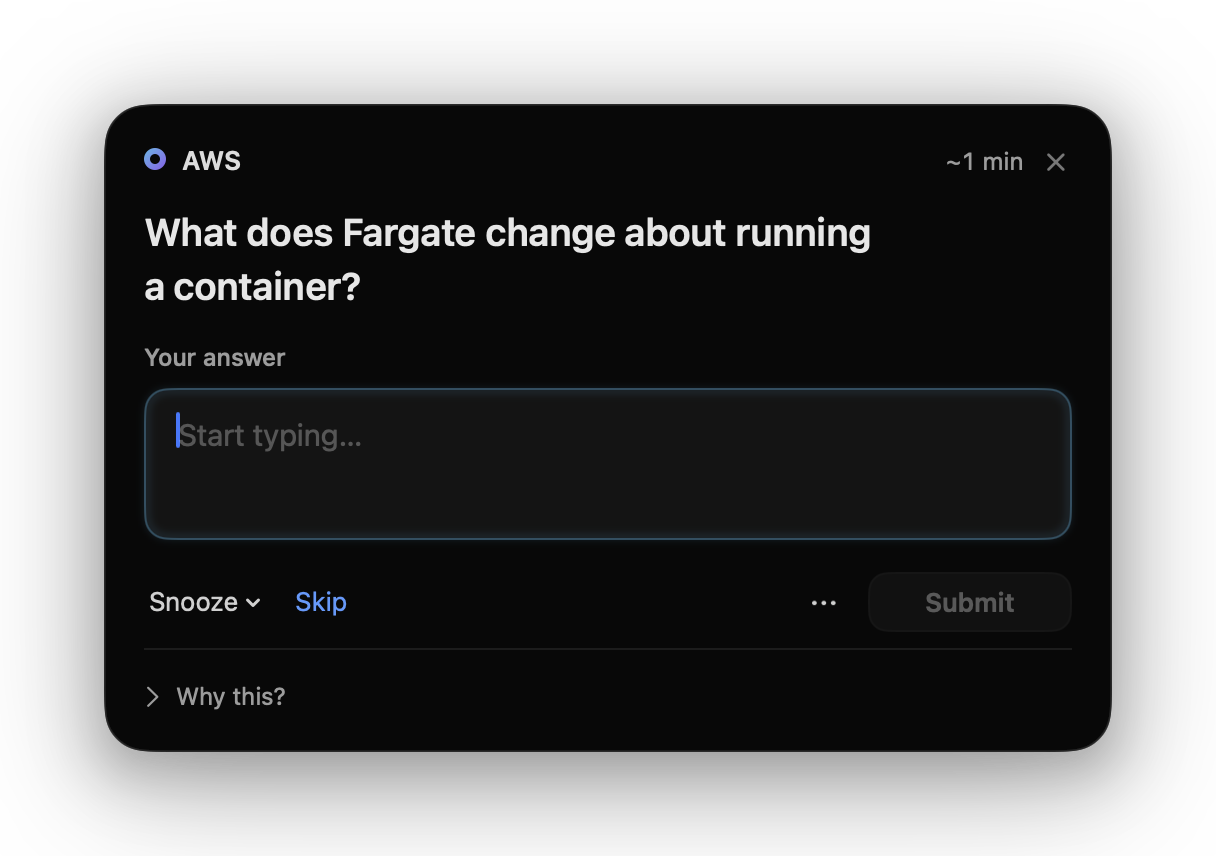
Cue puts one short, adapted question on your Mac a few times a day, then gets out of the way. No course to start. No session to book. Nothing to keep up with.
Then $29.99/year unless canceled
- macOS 13+
- Apple silicon or Intel
- 3 cards a day, tunable
- Works offline
- Windows soon
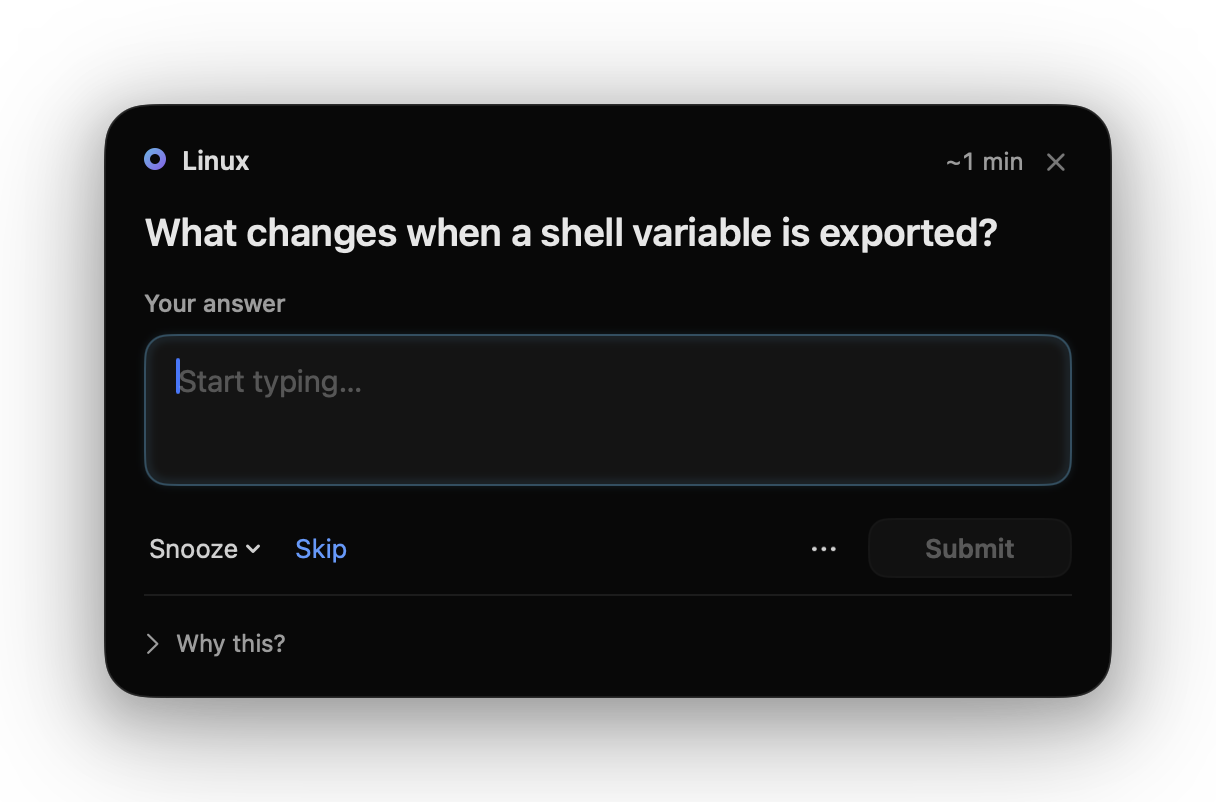
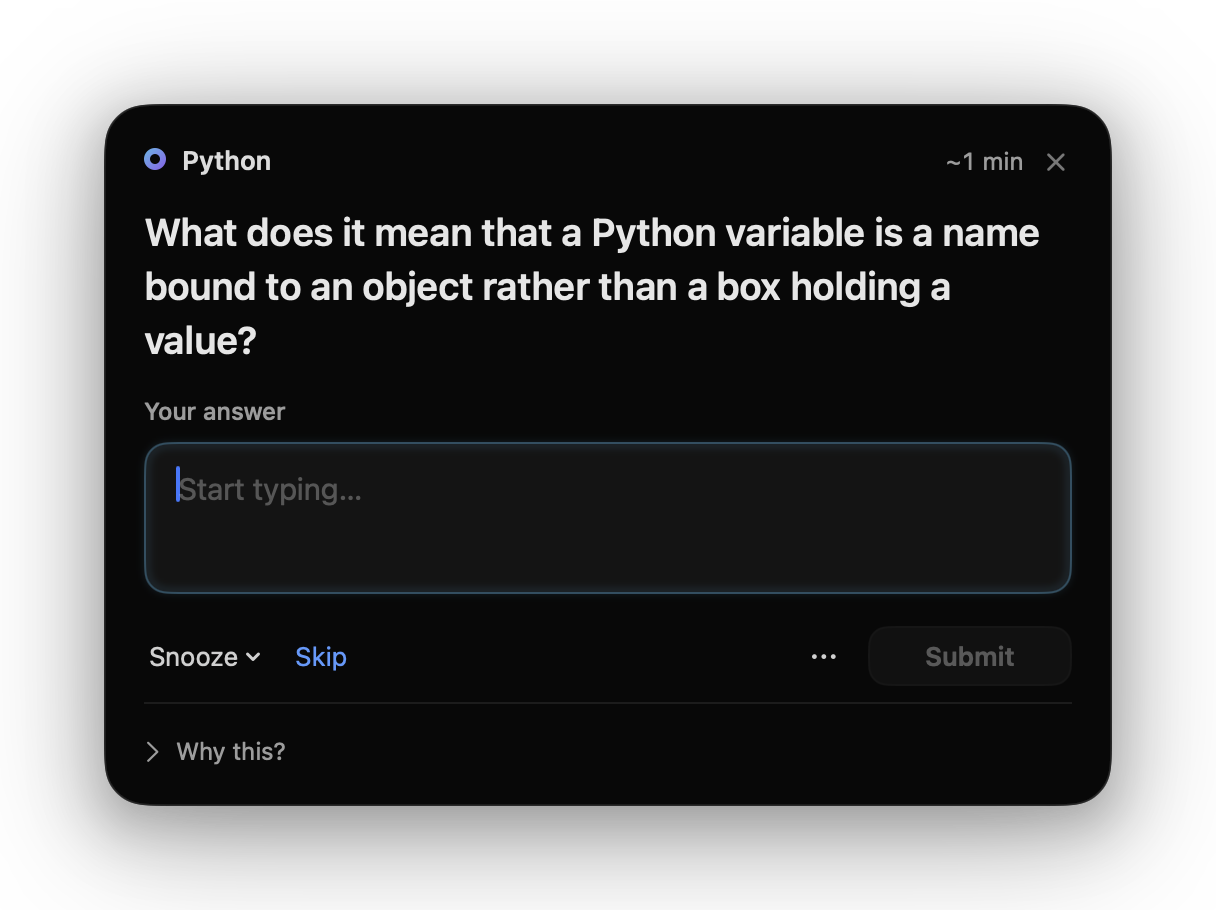
You already know how this goes.
You buy the course
Forty hours of video, lifetime access, a discount that expires tonight. You mean it.
You watch two lessons
Then a deploy breaks, or the week does. The tab closes. You will come back to it on the weekend.
It sits in your library
Six months on, the progress bar is still at four percent — and you still stumble on the question in the interview.
The material was never the problem. The problem is that it required you to show up — to find an hour, open the thing, and remember where you left off.
Cue reverses the direction. It shows up instead.
Small enough to answer between two other things.
One concept, about a minute. It appears over whatever you are doing and it has a visible close button — a thing that interrupts you should be easy to dismiss.
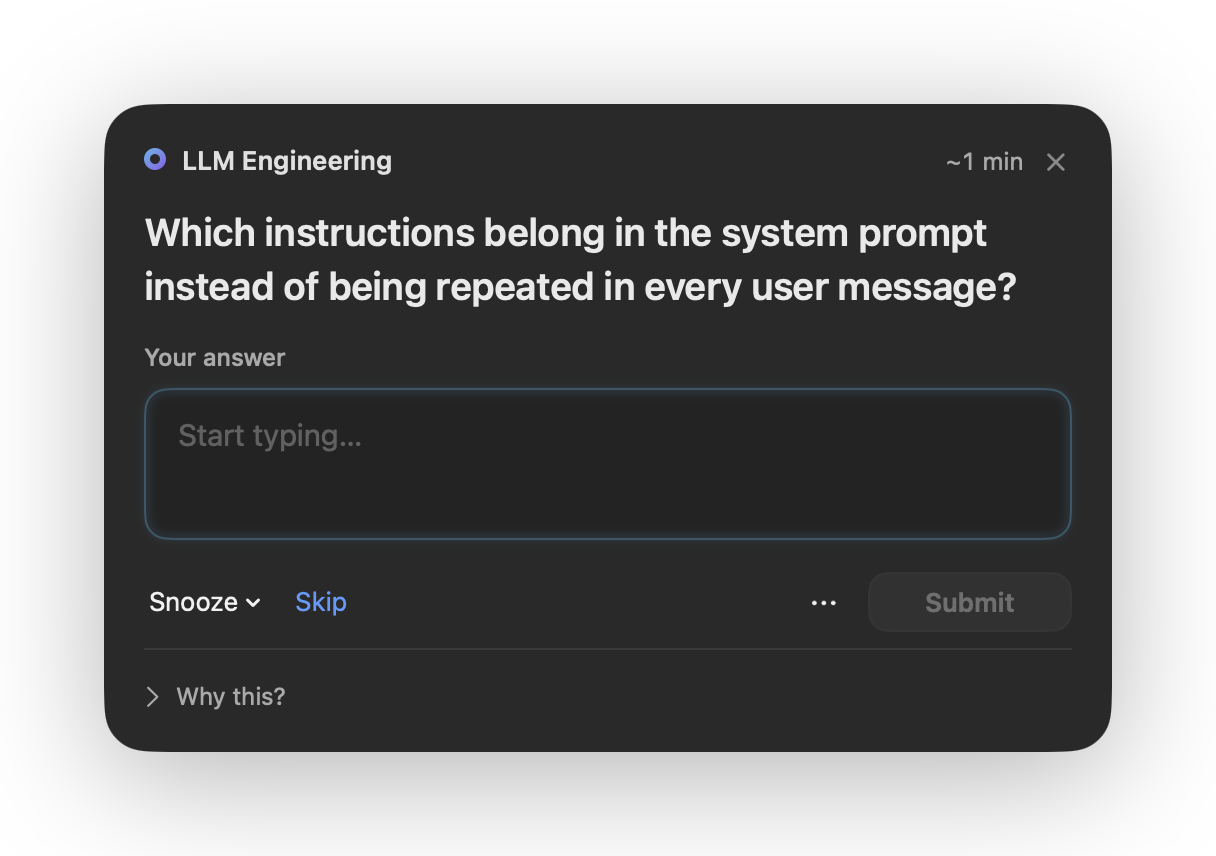
Recall, not recognition
An open question you answer in your own words. No multiple choice — picking the right option out of four proves you can recognise it, not that you can produce it.
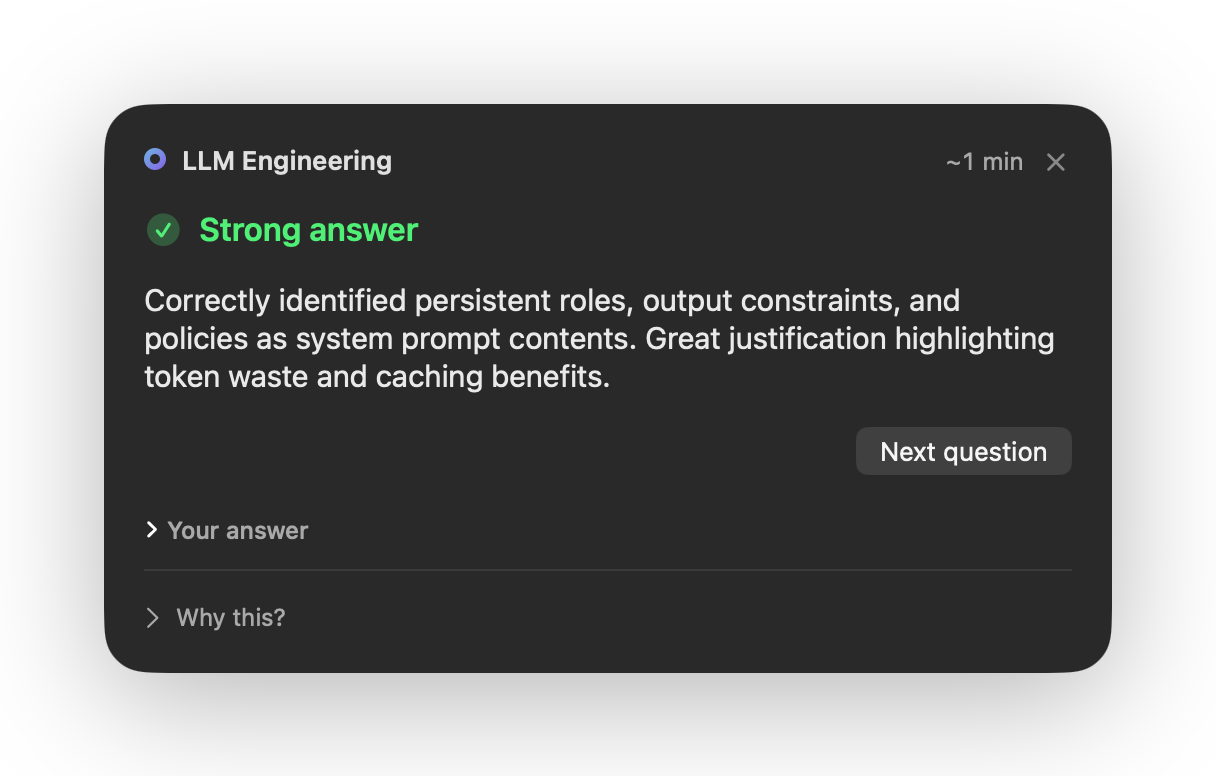
One idea, not a report card
Feedback leads with the single thing that mattered, and all of it is visible at once. Nothing hides behind a disclosure arrow you have to click.
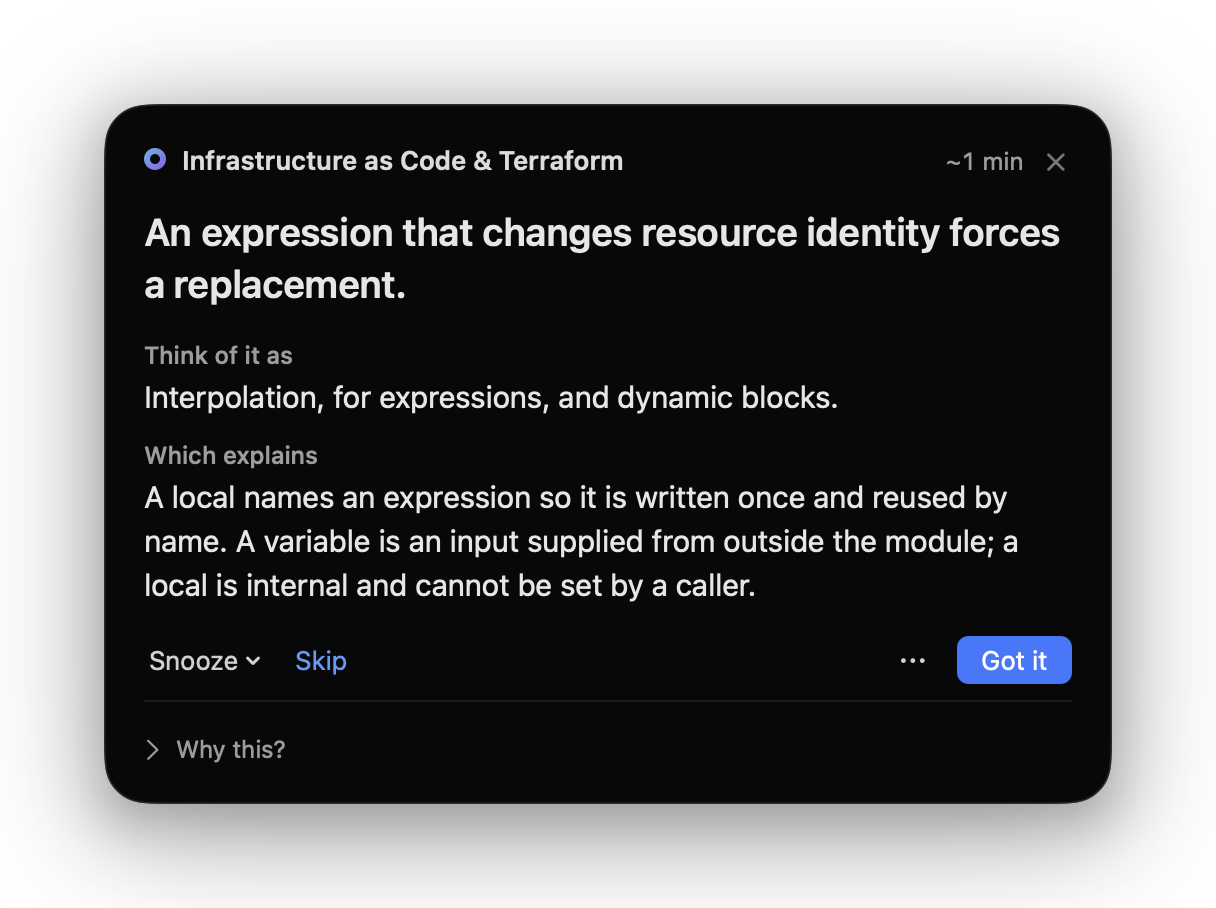
Teaching that is not a slide
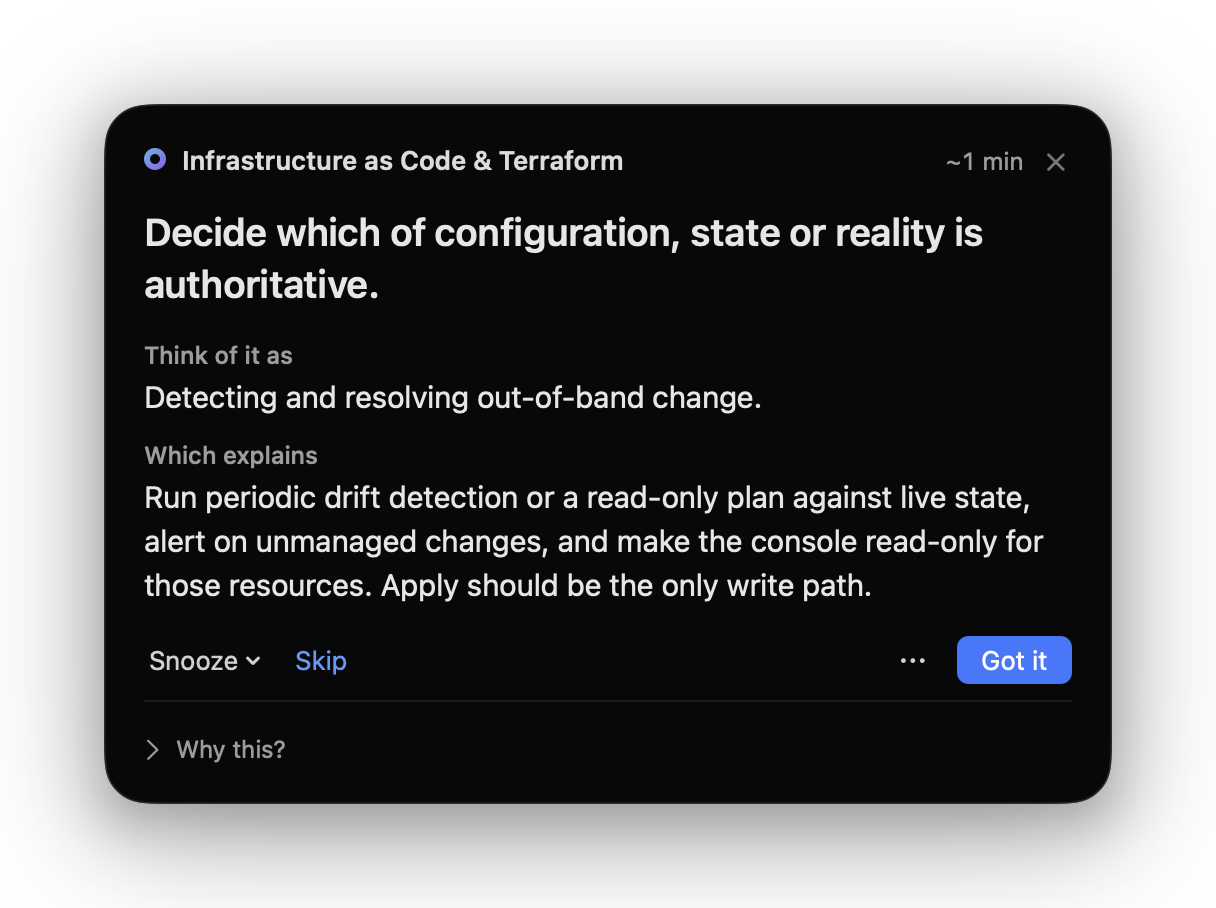
When a concept is new you get the claim, an analogy for it, and why it holds — then a Got it button. It is shaped like an idea, not like documentation.
How it works
Set it up once. Then stop thinking about it.
- 01
Pick a path
Five career paths, or assemble your own from a catalog of 29 subjects. Cue builds the curriculum, then a short diagnostic sets your starting level so it does not teach you things you already know.
- 02
It arrives while you work
Three cards a day by default, inside the hours you choose, at least ninety minutes apart, never in your quiet hours. You set all of it, and you can pause for a day or a week from the menu bar.
- 03
Answer in about a minute
You type a sentence or two in your own words. Cue grades it, leads with the one idea that mattered, and books the next review of that concept for roughly when you would have forgotten it.
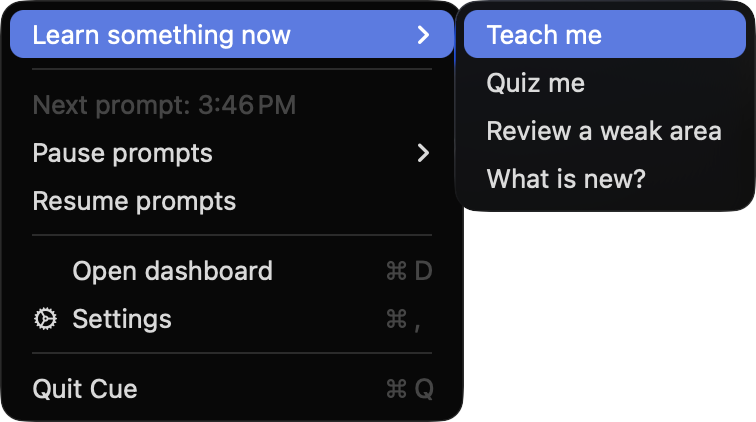
Cue lives in the menu bar. It tells you when the next card is due, and it stops the moment you say so.
Learning paths
Start from the job you actually do.
Five career paths, drawn from one shared catalog of 29 subjects. Each path weights its subjects and sets a target level for each, so Cue knows the difference between something core to your role and something you only need an awareness of. Retune any of it, or build your own.
Software Engineer
Broad software-development capability across code, collaboration, data, services, and design.
11 subjects363+ cards ready
A question you might get A one-line product change required edits in eight packages. What is that a symptom of?
Code Design & Architecture
Backend Engineer
Build and operate services, APIs, data access layers, and distributed applications.
14 subjects718+ cards ready
A question you might get Two checkouts both read quantity 1 and both sell it. Which isolation failure is that?
Databases & SQL
Cloud / DevOps Engineer
Automate infrastructure, delivery, and cloud operations.
14 subjects746+ cards ready
A question you might get Two pipelines apply against the same unlocked state. What corruption can occur?
Infrastructure as Code & Terraform
SRE / Platform Engineer
Own reliability, operational scale, shared platforms, and developer enablement.
15 subjects767+ cards ready
A question you might get Ten instances publish p99 latency. Why can their average not produce the service p99?
SRE & Reliability
AI Engineer
Build production applications around foundation models.
14 subjects500+ cards ready
A question you might get A retrieved web page tells the model to ignore its task and call a tool. What attack is this?
LLM Engineering
Custom
Choose and weight your own subjects, and set a target level for each.
Choose from all 29 subjects
The catalog
- Programming Fundamentals
- Data Structures & Algorithms
- Python
- JavaScript & TypeScript
- Git & Version Control
- Testing & Quality
- Debugging & Troubleshooting
- Code Design & Architecture
- APIs & Backend Engineering
- Databases & SQL
- Distributed Systems
- System Design
- Linux
- Networking
- Containers & Docker
- Kubernetes
- Cloud Fundamentals
- AWS
- Infrastructure as Code & Terraform
- CI/CD & Delivery
- Observability
- SRE & Reliability
- Platform Engineering
- Application & Cloud Security
- Performance Engineering
- LLM Engineering
- Retrieval-Augmented Generation
- Agents & Tool Use
- AI Evaluation
Why it sticks
Built for short attention, not long sessions.
It aims at your weak spots
A priority engine picks the next concept from your mastery, what is overdue, and how heavily your goal weights the subject. It is a decision, not a playlist position.
Spaced review, handled for you
Concepts come back on a schedule set by how well you answered. If a later answer proves you already know something, the card queued for it is dropped instead of asked.
It backs off when ignored
Skip a few in a row and Cue stops for the rest of the day and offers to lower the cadence. It is built to be ignorable — which is why it is still there in month six.
Works with no network
Cards come from a local cache. Answers and actions queue in a durable outbox and reconcile in a single batch when you reconnect. A plane is a normal place to use it.
Progress in plain words
Six bands instead of a fake percentage. No streaks to break, no badges. Goals shape what gets scheduled; they are not trophies.
Quiet about you
Operational logs carry a request ID, the route and a duration — not your answers, not your queries, not your source text.
The six bands
- Not started→
- Just introduced→
- Developing→
- Getting there→
- Solid→
- Strong
A dashboard you are not required to visit.
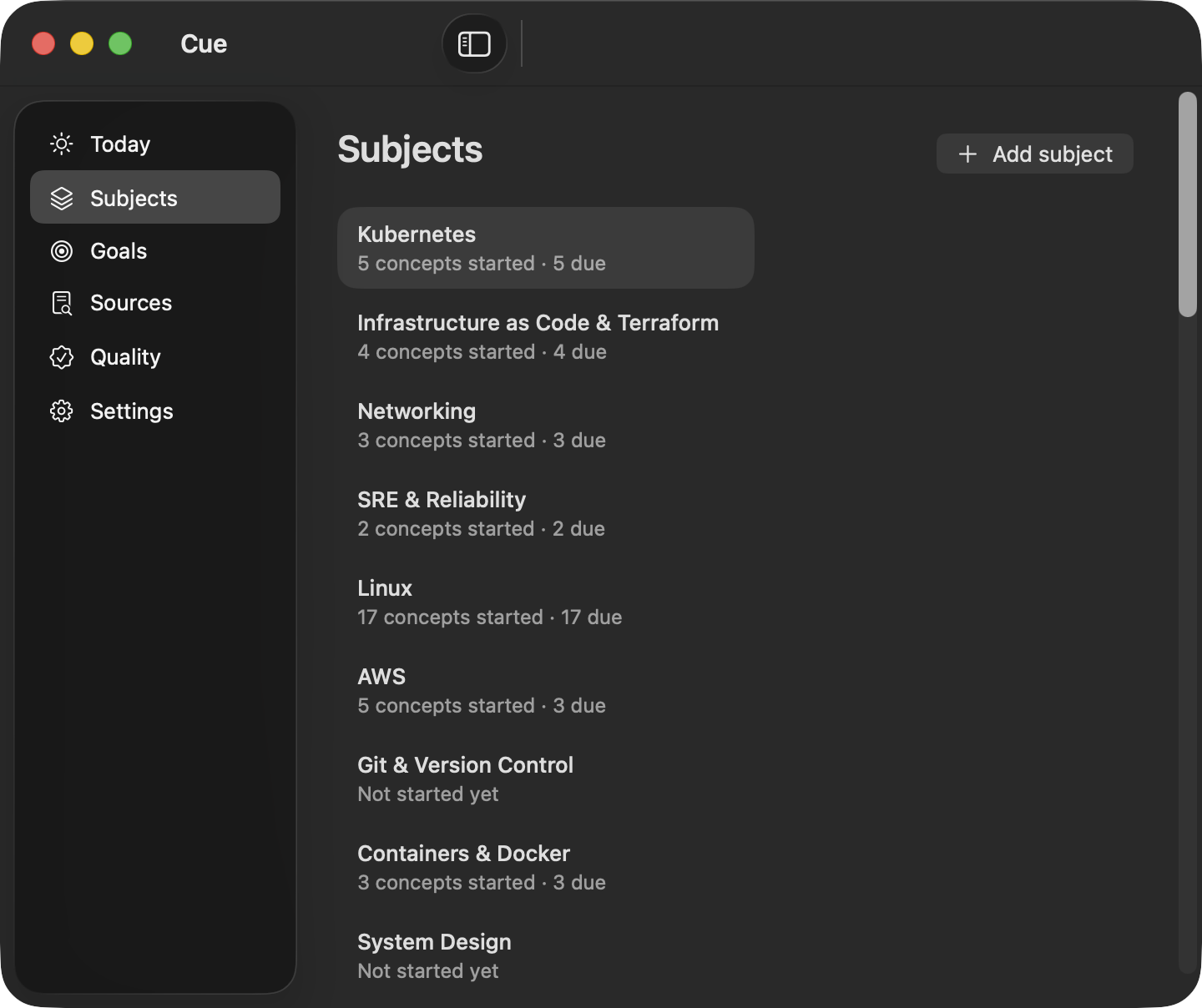
Cue works entirely from the card and the menu bar. When you do want the whole picture — what is due, which subjects are moving, what your goal is actually weighting — it is one keystroke away, and it reads from a cached snapshot so it opens offline too.
Progress is stated in words rather than a percentage, because a percentage of a subject is not a real number.
Pricing
Seven days free. Then cheap enough to forget.
Try the complete product for seven days. Add a payment method when you start; cancel before the trial ends and you will not be charged. After that it is billed once a year.
about $2.50 a month · billed once
- All five career paths and all 29 subjects
- Unlimited cards and unlimited graded answers
- No credits, no usage caps, no fair-use asterisk
- Every update while you are subscribed
- Full offline use
- Windows, included, when it ships
Card required · $29.99/year after 7 days · Cancel any time · 14-day refund after a charge
Get Cue
Set-up takes a couple of minutes: pick a path, answer a short diagnostic, choose your hours. The first card arrives the same day.

macOS
Signed and notarized disk image. Drag it to Applications.
Try free for 7 daysAlready subscribed? Download Cue- Requires
- macOS 13 or later
- Architecture
- Apple silicon or Intel
Windows
In development. Same card, same paths, same subscription.
One email when it ships. Nothing else.
macOS 13 or later · Apple silicon or Intel